

There is a time-honored stereotype in America that is not only racist, but it’s also factually incorrect. It’s a racial truth that has been crushed to the earth for a long time and now has risen again in Arkansas, but unfortunately for some in America, Jack Nicholson said it best in the movie A Few Good Men: they “can’t handle the truth”!!!
Last month, Arkansas Governor Sarah Huckabee Sanders posted a political ad for her reelection campaign on social media. In the ad, a young man sits on a lounge chair playing a video game, eating cheese balls and potato chips while Gov. Sanders narrates, saying: “Brad has turned relaxing into a full-time profession, but you, you actually work hard. You pay taxes to cover welfare for guys like Brad, who just choose not to work. That’s why I launched a welfare-to-work requirement. Now, more Arkansans are working than ever before, even Brad”.
Some critics online don’t like my welfare work requirement ad. Next thing you know they’ll say I should have used cookies instead of cheese balls. If you are able-bodied you should not collect welfare simply because you choose not to work. Period. WATCH->
— Sarah Huckabee Sanders (@SarahHuckabee) September 28, 2026
Since this was the typical anti-social welfare government spending political ad Republicans are known for, the reaction to it by MAGA Republicans was not anticipated by Gov. Sanders and her political team. Reactions ranged from demanding an apology from Sanders for the ad, to demanding the ad be taken down, to demanding the staff who produced it be fired. For eons, the inappropriateness of government-funded welfare benefits, along with the fraud and abuse by non-white citizens, has been one of the main political themes of Republicans’ policy goals, political ads, and political stump speeches.
In fact, Republicans’ use of the welfare political ad template picturing a lazy person of color, unwilling to work, instead choosing to lounge around and game the welfare system for benefits, is second only to Republicans’ use of the crime political ad template of an American black male committing a violent crime. Except this time, Gov. Sanders’ political ad depicted a slight change to the usual Republican welfare template and, by doing so, it committed a MAGA Republican cardinal sin. Instead of the lazy Brad, who was gaming the welfare system for unearned benefits, being a person of color in Gov. Sanders’ ad, the lazy Brad depicted gaming the welfare system was an American white male!!! MAGA Republican criticism of Gov. Sanders was swift and severe.
“Terrible ad that is so dishonest and insulting that it will entirely overshadow the genuinely great policy”, said Co-founder and CEO of The Federalist, Sean Davis. Will Chamberlain, senior counsel at the Article III Project, posted on X, “You should fire the consultants who made this ad; do not portray your core voting bloc as losers, period.” American Principles Project’s Caleb Pascoe said: “Attacking white (specifically Christian) young men is the most acceptable political tactic in America thanks to the evils of liberalism. It’s staggering how much even the majority of GOP politicians feel safe attacking white young men, instead of communicating the truth of welfare, because they might get called ‘racist’ or whatever”.
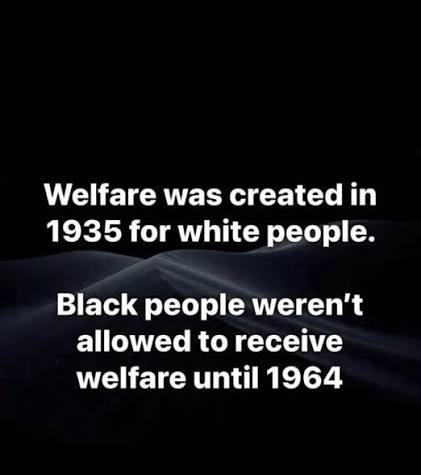
The Daily Wire’s Matt Walsh responded by saying: “White males are the Republican Party’s voting base, and yet they are the group the Republican Party shits on at every possible opportunity. Meanwhile, back in reality, women are significantly more likely to be on welfare than men. And black people are astronomically more likely to be on welfare than white people. So the number of single young white male ‘Brads’ abusing the welfare system is minuscule”. And after Gov. Sanders responded to the criticism on X, The Federalist’s Davis responded to her response by saying: “Your ad targeted and mocked the one demographic—young white men—that is least likely to be on welfare and yet the most likely to be illegally locked out of the job market. Why”?
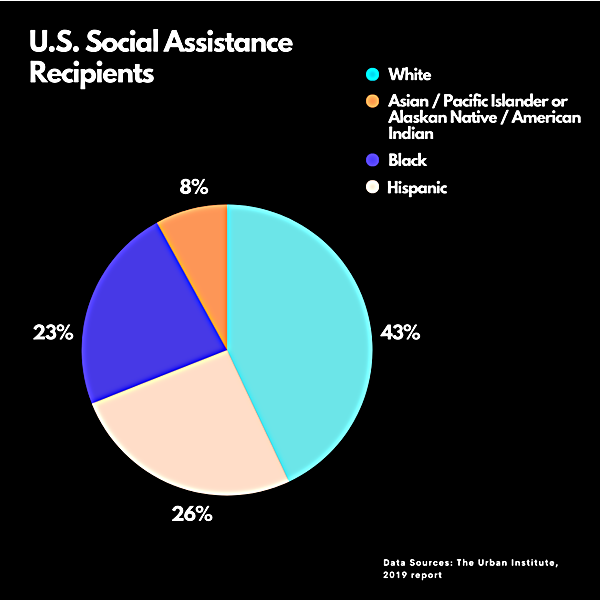
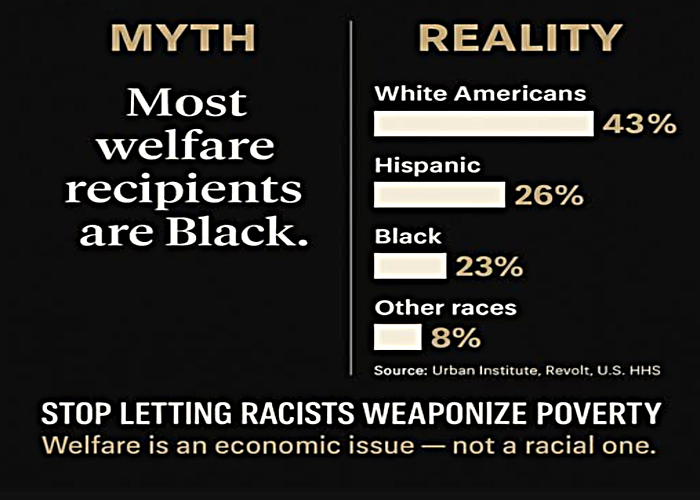
Based on their reactions, obviously, MAGA white pride has blinded many MAGA Republicans to the racial welfare facts. A racial truth that’s been crushed to the earth for decades, and is now rising again in Gov. Sanders political ad, is that there have always been more American Whites, and for the foreseeable future, there will always be more American Whites than American Blacks, American Hispanics, or American Asians who receive welfare benefits.
Conservatives who believe government spending should be strictly limited to national defense, border security, law enforcement, and basic infrastructure have crushed the racial welfare truth- that more whites receive welfare benefits than blacks- to the earth in an attempt to make government spending on social welfare programs unpopular. American white supremacists have crushed the racial welfare truth to the earth, and promoted the racial lie that more blacks than whites receive welfare benefits, in an attempt to validate claims that non-white people are inferior or subhuman compared to American Whites and need government assistance to survive. Regardless of their reasons, conservatives and white supremacists are both wrong; the racial truth is that more American Whites receive welfare benefits than American Blacks simply because there are more white people in America than there are black people in America.
There are 3 components to welfare benefits in America:
- SNAP (Supplemental Nutrition Assistance Program, formerly known as food stamps)
- Medicaid (low-income healthcare coverage)
- TANF (Temporary Assistance for Needy Families, commonly thought of as traditional “cash welfare”
The TANF program is the one everyone associates with welfare benefits because it’s temporary cash payments to support very low-income families with children. But TANF is the smallest component of welfare benefits, with only 1.8 million Americans receiving TANF benefits, and it’s the only welfare benefit where the racial numbers are nearly equal between white and black recipients. In Gov. Sanders’s Arkansas, TANF is administered through the state’s Transitional Employment Assistance (TEA). According to the U.S. Department of Health and Human Services, there are 2,500 to 3,000 Arkansans enrolled in TEA, with 900 to 1,200 being white and 1,300 to 1,600 being black.
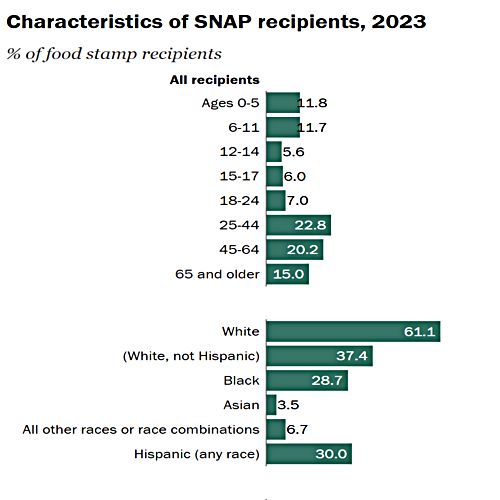
Source: U.S. Census Bureau, 2024 Survey of Income and Program Participation. PEW RESEARCH CENTER
The second largest component is SNAP, aka food stamps. According to the U.S. Department of Agriculture (USDA), there are 41 to 42 million Americans who receive food stamps, with 15 million to 16 million being white and 10.5 million to 11 million being black. The largest welfare component is Medicaid, with 85 to 90 million Americans receiving government-subsidized healthcare, of whom 34 million to 36 million are white, and 17 million to 18 million are black. Speaking to the truth of Gov. Sanders’s ad, according to Arkansas’s Department of Human Services, more than 60 percent of the 218,000 Medicaid expansion enrollees in Arkansas state are White, and only 18 percent are Black.
Kudos to Gov. Sanders’ political reelection ad for raising a racial truth that has been crushed to the earth for far too long in America; hopefully her ad will serve as a catalyst for raising the racial welfare truth throughout the rest of America, which then paves the road for America’s racial crime truth──that American Whites commit more violent crime than American Blacks do, simply because there are more American Whites in America than there are American Blacks──to rise to the full light of day and truth in America.